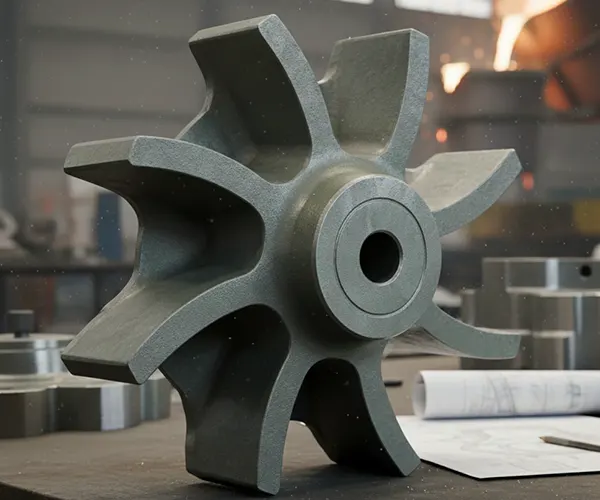
Among the factors influencing pump performance, complex impeller designs are among the most significant. But to produce these intricate geometries, one will have to rely on casting mastery and fine tools paired with good material knowledge. are just the ones who come to the rescue. With modern simulation technology, investment casting techniques, and CNC machining at their disposal, they produce impellers having exactly the right blade profiles, very smooth surfaces, and of the highest durability.
By merging engineering creativity with rigorous quality checks, top Pump Casting Manufacturers guarantee every impeller is fit for even the toughest performance standards. Their potentials are one of the main factors that make industries realize dependable, efficient, and durable pump operations.
Understanding the Complexity of Impeller Manufacturing
In the case of high-performance impellers, the manufacturers have to deal with complexity regarding the shape, the number of vanes, and the precision requirements in the dimensions. Also, the pump casting manufacturers should produce such components that are able to manage the fluid movement efficiently and at the same time not weaken the structure. Hence, complex designs call for extraordinary accuracy since even slight variations might lead to a significant drop in the hydraulic performance.
The most important factors adding up to the complexity:
- The use of different types of impellers: open, semi-open, and closed
- The existence of thin, curved blades that need very precise dimensions
- The geometries that are critical regarding tolerance for a balanced rotation
- The presence of complicated internal flow channels
- The necessity of having the surfaces perfectly smooth to minimize friction losses
The Importance of Precision in Impeller Casting
The precision of the casting has a direct impact on pumping efficiency, power consumption, and reliability over the years. The goal of the Manufacturers of Pump Castings is to make impellers that provide constant flow, small vibrations, and great performance. The use of precision casting results in reduced machining and guaranteed quality.
The Benefits of Precision:
- Guarantees maximum flow rate and pressure out
- Lower vibration and noise levels
- Less energy is consumed during operation.
- Increased wear resistance
- Enhancement of pump life cycle—overall pump service life.
Common Challenges Faced by Pump Casting Manufacturers
Manufacturing impellers is a complex process because of the delicate blades, the precise tolerances, and the intricate internal structures. Pump Casting Manufacturers have to deal with a lot of casting issues to get flawless parts.
Main Challenges:
- Porosity and shrinkage in thin sections are controlling.
- Metal flows into intricate mould cavities with uniformity, achieving.
- Dimensional accuracy in the curved vane maintenance.g
- Inclusions and surface defects are preventing.
- Smooth pump rotation, balanced weight, ensuring.g
Material Selection for High-Performance Impellers
Selecting the appropriate metal is very important in terms of durability, corrosion resistance, and application performance. The pump casting manufacturers analyze the working conditions and choose the best alloy for casting.
Common Materials:
- Stainless steel for corrosion resistance
- Duplex and super duplex for high strength
- Bronze for marine and seawater applications
- Alloy steel for heavy-duty industrial use
- Nickel-based alloys for extreme environments
Modern Design Tools Enabling Complex Impeller Casting
The most up-to-date digital tools are at the core of every modern impeller design. Using state-of-the-art software, Pump Casting Manufacturers can visualize, test, and refine designs, thereby guaranteeing the correctness of performance before actual production.
Main Instruments Employed:
- CAD for creating 3D representations of the blades and passages
- CFD to mimic fluid movement and make the flow better
- CAM to uhmmm... organize machining and finishing activities
- Design optimization algorithms to figure out the minimum weight and maximum strength
- Digital prototyping to lessen design mistakes
Advanced Casting Techniques Employed for Impellers
Based on the requirements of the impellers, industries differ, and therefore, manufacturers use different casting methods according to the complexity and size. Pump Casting Manufacturers determine the method that best fits the needs of the product and use it to ensure the right level of precision, finishing, and durability.
Main Casting Methods:
- Investment Casting for extremely detailed and accurate impellers
- Sand Casting for very big, sturdy, and heavy-duty impellers
- Lost-Wax Casting for delicate and thin-blade structures
- Shell Moulding for better dimensional stability
- Hybrid methods mixing casting + machining
Step-by-Step Impeller Casting Workflow
A high-quality impeller can only be produced through a serious and detailed multi-stage process. Pump Casting Manufacturers use a systematic workflow that guarantees the same output.
Process Steps:
1. Pattern & Wax Model Creation: Designing and forming accurate wax patterns
2. Shell or Mould Preparation: Building strong ceramic or sand moulds
3. Metal Melting & Pouring: Filling the mould with molten alloy
4. Cooling & Solidification: Controlled cooling for defect prevention
5. Knockout & Fettling: Removing the mould and cleaning cast parts
6. Heat Treatment: Enhancing strength and durability
7. Final Finishing: Preparing impellers for machining and polishing
How Simulation Technology Reduces Casting Defects
Simulation technology has done a marvelous thing for impeller casting. It has made it possible to detect problems before the actual production starts. Manufacturers of Pump Castings use top-notch software to simulate various processes, such as the flow of the metal, cooling, and solidifying.
Advantages of Simulation:
- Early identification of shrinkage and porosity risks
- Predicts metal flow behavior in narrow blade areas
- Improvement of gate and riser design
- Reduction of costs associated with trial-and-error production
- Getting close to perfect casting from the very first attempt
Quality Control Techniques Utilized by Major Manufacturers
Application of continuously verified quality control makes it possible for even the least good quality impellers to be thrown away without the risk of them entering the market. Pump Casting Factory uses state-of-the-art technology to control the production process at every step, from the melting of the metal to the final quality checks of the cones.
Quality Control Method:
- Non-destructive Testing: supersonic, magnetic particle, and dye penetration tests
- X-ray: Exposes hidden errors and cavities
- CMM: Guarantees accurate dimensions
- Hardness & Pressure Tests: Certify the strength of the material
- Surface Roughness: Smoothness requirement for the blade profile
Custom Impeller Manufacturing Capabilities
Several industries need specific impeller shapes that suit their particular applications. Pump Casting Manufacturers provide a wide range of customization options through their advanced engineering and prototyping.
Customization Features:
- Reverse engineering of old or damaged impellers
- Prototyping with 3D printing
- Variable blade angles and shapes of vanes
- Alloys specifically designed for special environments.
- Production options for small-batch and large-volume
CNC Machining Advanced Impeller Output
CNC machining processes enhance the cast impellers by upgrading their dimensional accuracy, surface quality, and balance. The Pump Casting Manufacturers consequently apply the machining processes to meet the final performance standards of industrial pumps.
Machining Contributions:
- Precise cutting and shaping of blades
- Making of very small tolerances
- Getting rid of the casting marks completely
- Performing dynamic balancing for vibration-free operation
- Polishing for the improvement of hydraulic efficiency
The Importance of Picking the Right Pump Casting Manufacturer
Just the selection of a skilled manufacturer will get you the best pump performance, lowest lifecycle cost, and most reliable operation. Pump Casting Manufacturers with skill can produce perfectly made impellers that give the same output over the whole range of the application.
Main Factors Influencing the Decision:
- Possibility of using the latest casting methods
- Assured quality and delivery on time
- Ability to master difficult shapes
- Deep understanding of materials for picking the right alloy
- Possibility of providing tailored products and a complete support service
Conclusion
The advanced engineering, precision casting techniques, and stringent quality control that come with complex impeller designs are demanded for reliable operation in the most difficult applications. Today's Pump Casting Manufacturers, using simulation tools, picking the best materials, and employing CNC machining, are the ones that can make it possible to produce high-accuracy impellers that possess outstanding durability and efficiency at the same time. When the industries go for the experienced Pump Casting Manufacturers, they get reliable components that boost the performance of the pumps, minimize maintenance, and provide long-term operational reliability in every working environment.
FAQs
1. What are the difficulties that are faced during the impeller casting process?
Among the challenges are the thin blades, the complex geometries, the need for uniform solidification, and the prevention of porosity.
2. What casting method can be considered the best for precision impellers?
It is investment casting that is most suitable for the manufacture of intricate, high-precision designs for impellers.
3. How do manufacturers ensure errors in impellers?
Defect-free impellers are the result of the use of simulation tools, non-destructive testing (NDT), controlled cooling, and strict quality assurance procedures.
4. Can Pump Casting Manufacturers create custom impeller designs?
Yes, custom geometries can be produced using advanced CAD modeling and reverse engineering.
5. Which materials are generally used the most for casting of impellers?
Stainless steel, bronze, duplex steel, and strong alloys are used depending on the application
